
Paid Family Leave Begins January 1, 2018

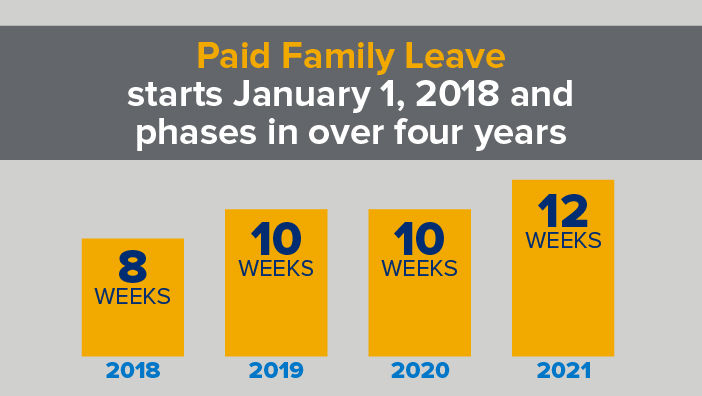
Beginning January 1, 2018, New York State will be offering Paid Family Leave to all private employees. This benefit does not apply to state employees. This is a 100% employee-funded benefit that will mandate up to 12 weeks of job-protected paid leave once it is fully implemented in 2021. In 2018, leave time is 8 weeks, increasing to 10 weeks in 2019 and 2020, then finally capping at 12 weeks in 2021. Employees are guaranteed the same or similar job upon their return and maintain health insurance while on leave.
Paid leave can be used to care for a seriously ill family member, bonding with a newborn, adopted or foster child, and time to attend to family matters due to a qualifying military exigency. Both men and women will be able to take advantage of this new benefit. Further, those who had a child or adopted a child in 2017 are eligible to take paid time off in 2018 as long as it is within 52 weeks of birth/adoption date.
Full time employees (20+ hours/week) are eligible for this benefit after 26 weeks of employment while part time employees (under 20 hours/week) are eligible after 175 days of work. Part time employees are able to opt out of Paid Family Leave coverage with a waiver.
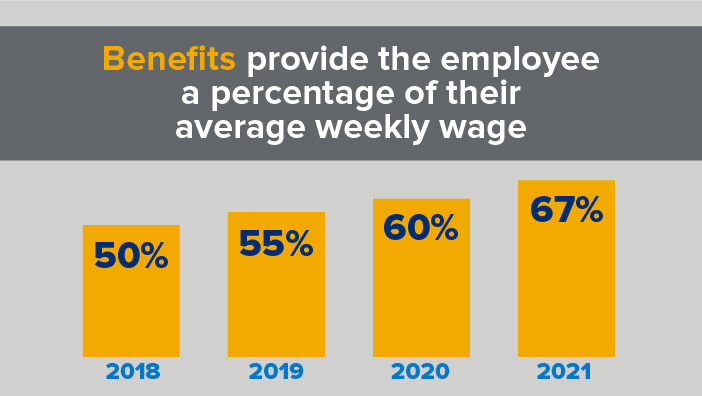
The benefit begins at 50% of the employee’s average weekly wage (capped by NY) and will increase to 67% in 2021. Employees at or above the statewide average weekly wage (SAWW) are eligible only for the maximum family leave benefit; therefore, their premiums will be a percentage of SAWW. The SAWW for 2018 is $1,305.92 making the maximum weekly contribution $1.65. Employees with a salary of $67,907.84 will be subject to maximum limits.
The charts below illustrate how the program will benefits will increase each year over the next four years.
You can read more about the program here.
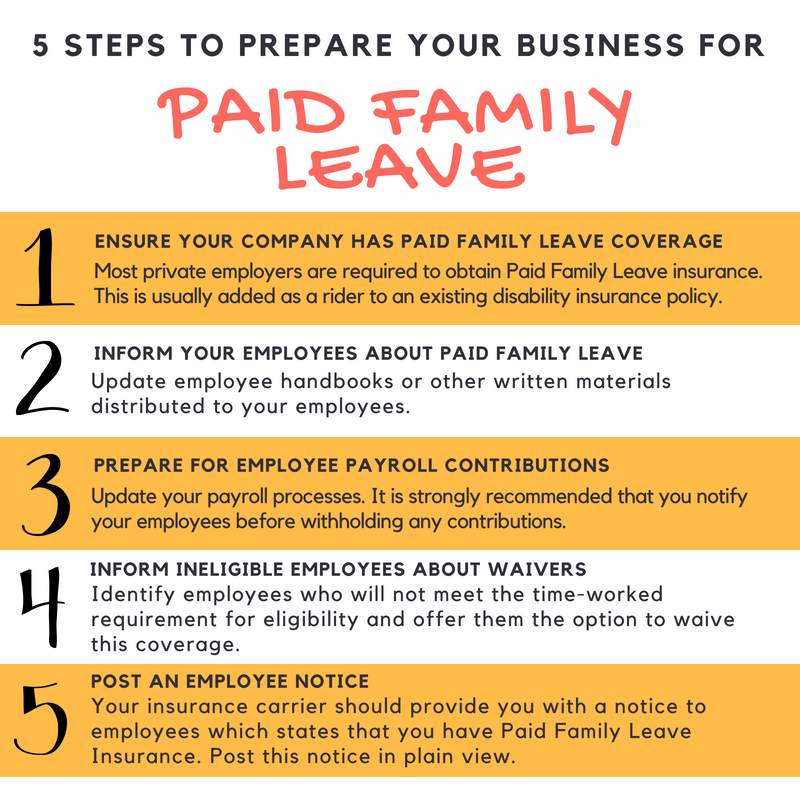
There are steps you can take to prepare your business for Paid Family Leave:
PAID FAMILY LEAVE UPDATES:
Payroll Deduction Changes
Employers do not need to cap the weekly employee payroll deduction for Paid Family Leave at .126% of the New York State Average Weekly Wage (NYSAWW) (approximately $1.65 per week in 2018.) Instead, employers may deduct .126% of an employee’s weekly wage until the employee hits the annual cap of $85.56, which is .126% of the annualized NYSAWW.
This applies to employees with a weekly earning greater than the current NYSAWW ($1,305.92).
This update will better position employers to collect the full Paid Family Leave premium from each employee. Certain employees will now meet their annual maximum PFL deduction of $85.56 before the year is over.
You can estimate weekly deductions by using the PFL weekly payroll deduction calculator here.
If you have any questions about how this will affect your business, you should contact your payroll company. You should also notify employees of these changes.
Bereavement Amendment Passed
On June 20, 2018 an amendment was passed by the New York State Assembly which will allow eligible employees to take paid time off for bereavement. This law will become effective January 1, 2020.
The amendment is part of Paid Family Leave (PFL) as follows:
- Bereavement will now be included in the provision of PFL that covers caring for a seriously ill family member.
- Qualifying family members for paid bereavement under this provision will be spouses, children, step-children, parents, parent-in-laws, stepparents, grandchildren and domestic partners.
Bereavement has also been added to PFL as a category separate from bonding with a child, caring for a family member with a serious health condition, or qualifying military exigency. Under this new category, bereavement is covered for a family member that was not seriously ill. We are still awaiting guidance on which family members will qualify for PFL under this new bereavement category.
In order to take paid bereavement leave, there is no set time limit for when an employee must inform his or her employer since this type of leave is tied to an unplanned or sudden occurrence. The employee will only need to inform the employer as soon as practicable and a death certificate will serve as proof for the need for the leave.
You can read the full amendment here.
What do our clients have to say?
News & Events
Winter Newsletter 2018
A special thank you! As 2018 comes to an end, we would like to thank all of our clients for your...
Read moreMissed Open Enrollment? Options for Coverage for 2019
Open Enrollment ended on December 15th. Most people need to wait until next year's Open Enrollment...
Read moreDNA Testing Kits and Life Insurance
DNA Testing Kits, such as 23andMe, have become a popular item. They are tests that allow...
Read moreCrowdfunding to Pay for Medical Costs
It's no surprise that healthcare costs are on the rise in America. After all, healthcare in the US...
Read moreStay Healthy This Holiday Travel Season
Do you have plans to travel this holiday season? We'd like to help keep you healthy and away from...
Read moreHow to Open an HSA: What You Need to Know About Health Savings Accounts
An HSA is a Health Savings Account where you can put aside pre-tax dollars to pay for qualifying...
Read more